Robert Hall and Michael Woodford win 2026 Nobel economics prize
US economists Robert Hall and Michael Woodford won the 2026 Nobel economics prize for models that help policymakers stabilise economies. Their research examines how households and businesses respond to policy and underpins tools used by central banks and finance ministries.
africanews.comTwo Americans win 2026 Nobel Prize in Economics for stabilisation models
theguardian.comNobel Prize for economics awarded to Hall and Woodford for work on ‘smoothing’ crises
Award for stabilisation research
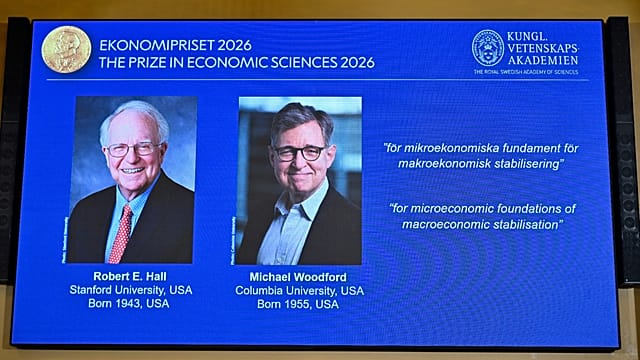
Robert Hall of Stanford University and Michael Woodford of Columbia University were awarded the 2026 Nobel economics prize on Monday for developing the “microeconomic foundations of macroeconomic stabilisation”. Their work gives policymakers tools to manage economic fluctuations through monetary and fiscal policy.
The Royal Swedish Academy of Sciences described their research as producing “a paradigm shift in stabilisation policy”. The pair will share prize money worth $1.2 million.
How the models work
The research helped rebuild stabilisation models around the decisions of individual households and businesses, rather than relying on statistical relationships between broad economic measures. Earlier Keynesian models had struggled during the oil shocks of the 1970s, when high inflation coincided with weak growth and high unemployment.
Hall’s work emphasised that consumers look ahead when deciding whether to spend or save. Woodford built on that approach to develop a New Keynesian framework. The academy said models resulting from their research are now used by central banks and finance ministries around the world.
Policy communication and reaction
Their work also helped develop forward guidance, in which central banks communicate where they expect interest rates to move. It became an important tool after the 2008 financial crisis, when rates in many countries had already been lowered to zero, limiting traditional monetary policy options.
Woodford said clearer communication had contributed to stabilisation, while cautioning that it had not “magically” solved the problem. He described the prize as a surprise and “a tremendous honour”, and said his research sought to improve economic policy discussion rather than advance a specific political agenda.